Markets, Bubbles & Inequality
Silicon Valley Bank & Capitalism
The perspectives presented in the following essay are developed for the purpose of academic analysis and do not necessarily reflect my personal views, which differ from the position explored here.
The past two weeks have been historic for the capital markets because a dozen of portfolio managers at various different hedge funds have been busted. They speculated by betting heavily on interest rates rising but an improbable tail event (bank failure) knocked them out. Hundreds of millions of dollars were lost and many traders were fired. During the whole episode, I was just trying to fathom being in their predicament; since I myself lost money on an identical wager however the only difference was that mine was not a material loss.
During this event I recalled Mark Twain’s quote “history doesn’t repeat but it does rhyme”.
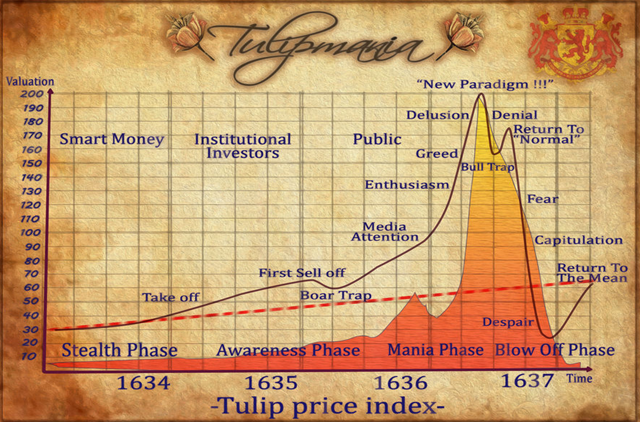
Thus I started reflecting on the first term’s history lessons on speculative bubbles to trace back the problem. Speculative bubbles are a recurring phenomenon in human history. They happen when a particular asset, be it a commodity or an idea, becomes the object of irrational exuberance and investors start pouring money into it, driving its price up to unsustainable levels. Eventually, the bubble bursts and the price collapses, causing massive losses for those who bought in at the peak. The most famous examples of speculative bubbles in history are probably the Tulipmania, the Mississippi Bubble, and the South Sea Bubble, all of which took place in the 17th and 18th centuries. At the peak of the bubble, a single tulip bulb could be sold for the equivalent of a luxury house in Amsterdam. However, the bubble burst in 1637, and prices collapsed, leaving many investors ruined. This sounded very familiar to the current crypto story a trillion-dollar industry minting billionaires right and left which was wiped out completely after the central bank started increasing interest rates. How was crypto different from the bubbles of the past? I couldn't find many distinctions between the crypto craze and the tulipmania. I recalled John Kenneth’s quote “Only after the speculative collapse does the truth emerge. What was thought to be unusual acuity turns out to be only a fortuitous and unfortunate association with the assets.”1 . I was puzzled about why the obvious history
lessons weren't clear to me and those who lost money in the choppy markets of the past few months. I drew conclusions during my history course that one should not invest based solely on hype or speculation, be wary of "get rich quick" schemes, and have a plan for when things go wrong. However, I forgot those lessons alongside those traders and had no hedges in places when it mattered the most.
Furthermore, I learned that poor people who feel trapped in an intergenerational; quagmire lost the most in these bubbles. This made me more aware of the inequalities of life that I shrugged off as natural. It reminded me of a rigged system. Where rich investors always end up unscathed for instance “SoftBank's stake in the firm is more than a hundred billion dollars-far exceeding all of Son's other losses."Venture capital has become a lottery"2. Investors like Masayoshi Son can lose billions and have no significant impact on their well-being but ordinary people with 401ks and RRSPs end up losing the most. Consequently, this made me realize speculators add no value but make an obscene amount of money may it be in the form of a venture capitalist or a wall street trader. This was a major realization since, throughout the course, my thought severely evolved from praising these roles to framing them as “value destructive”.I was first time introduced to the notion that society can’t benefit because professional speculators and robber barons bring inequality which breeds resentment.
Future contracts which were first traded in Japan in 1730 were meant to offset potential losses for farmers but largely their use has been to make money by speculating on wall street.
In addition to that, I also witnessed that a few people like Michael Milken and his private equity proteges who “issued bonds that financed takeovers”3 resulting in deliberate massive layoffs became rich on the backs of ordinary people. I was able to picture this inequality vividly by reading Kishtainy and I quote “After fifty minutes, immense figures sweep past lawyers five meters, surgeons nine meters tall. In the last seconds, giants towering miles into the airthud past. Some are executives in big companies like Apple and Facebook.”4 The only way one can understand wealth inequality is by associating height with people's wealth. No human is as tall as the Eiffel tower because such large discrepancies do not exist in nature but these inequalities only exist in capitalism-like structures. On further scrutiny, I tried to imagine how tall Jeff Bezos or Elon Musk would be. Subsequently, I tried to recollect the very first billionaire robber barons who were wealthy businessmen who gained their wealth through unethical business practices such as monopolies, price-fixing, and exploitation of workers. That is where my perception of history where i started giving weight to mark’s argument During the late 19th and early 20th centuries, these individuals accumulated immense wealth, leading to significant wealth inequality in the United States. Robber barons often used their wealth and influence to control government policies and regulations, which further contributed to their power and wealth accumulation. This system allowed them to maintain their wealth and influence for generations, leading to a widening gap between the rich and the poor. The conditions of workers in factories and mines were often terrible, with low wages, long hours, and dangerous working conditions. Workers were often subject to exploitation and abuse. Wealth inequality and the rise of robber barons had significant impacts on the development of the United States. The exploitation of workers and unethical business practices resulted in immense wealth accumulation by a few individuals, leading to significant wealth inequality. All of this reminded me that such dodgy practices are still very much present “John May, a stock analyst for a US investor service, pointed out that the pro forma earnings announcements by the NASDAQ 100 companies overstated their profits by $100 billion in the first nine months of 2001 as compared with their audited accounts when these finally appeared. Even those audited accounts, it now seems, were able to make things seem better than they really were”5
The monopolistic structure has somewhat stayed the same over the past decades there have
There has been a rise in global GDP but wealth remains concentrated in hands of a few. This was the same when Rockefeller existed and it is the same with the new class of billionaires
This has been a very radical development on a personal scale since I never thought about inequalities and injustices around me and that a history of capitalism course that was supposed to reinforce my preexisting views would lead to this outcome. This whole journey with history has been that of humility where I ended up believing different things regarding my capitalist heroes. The billionaires I admired as a child were not that great of men. In hindsight, I might have admired them because I was as unequal in my society as they were in theirs. A society that didn't reward nurses, doctors, and firefighters but the intergenerational landowners, and moneylenders like my family. I came to the conclusion that history has all the lessons but it is the arrogance of humans which leads them to repeat the same mistakes. This line of inquiry finally made me stumble upon the question of the value I would bring to the world if I end up working in high finance.
Works Cited
- Galbraith, John Kenneth. "The Common Denominators." In A Short History of Financial Euphoria,.
( New York: Penguin Books, 1990) Page 18
- Duhigg, Charles.“The Enablers.” New Yorker. November 30, 2022. Page 3
3 Krats Peter, "1987 Roller Coaster," PowerPoint presentation, Page 27
March 16, 2023, Western University, London, ON.
- Kishtainy, Niall. “Giants in the Sky.”: A Little History of Economics.
(Yale University Press:2018.) Page 231
- Handy, Charles. "What is a Business For?" Harvard Business Review. Vol 80, (2002): Page 52.
- Krats Peter, "Big Players," PowerPoint presentation, Page 19
November 8, 2022, Western University, London, ON.